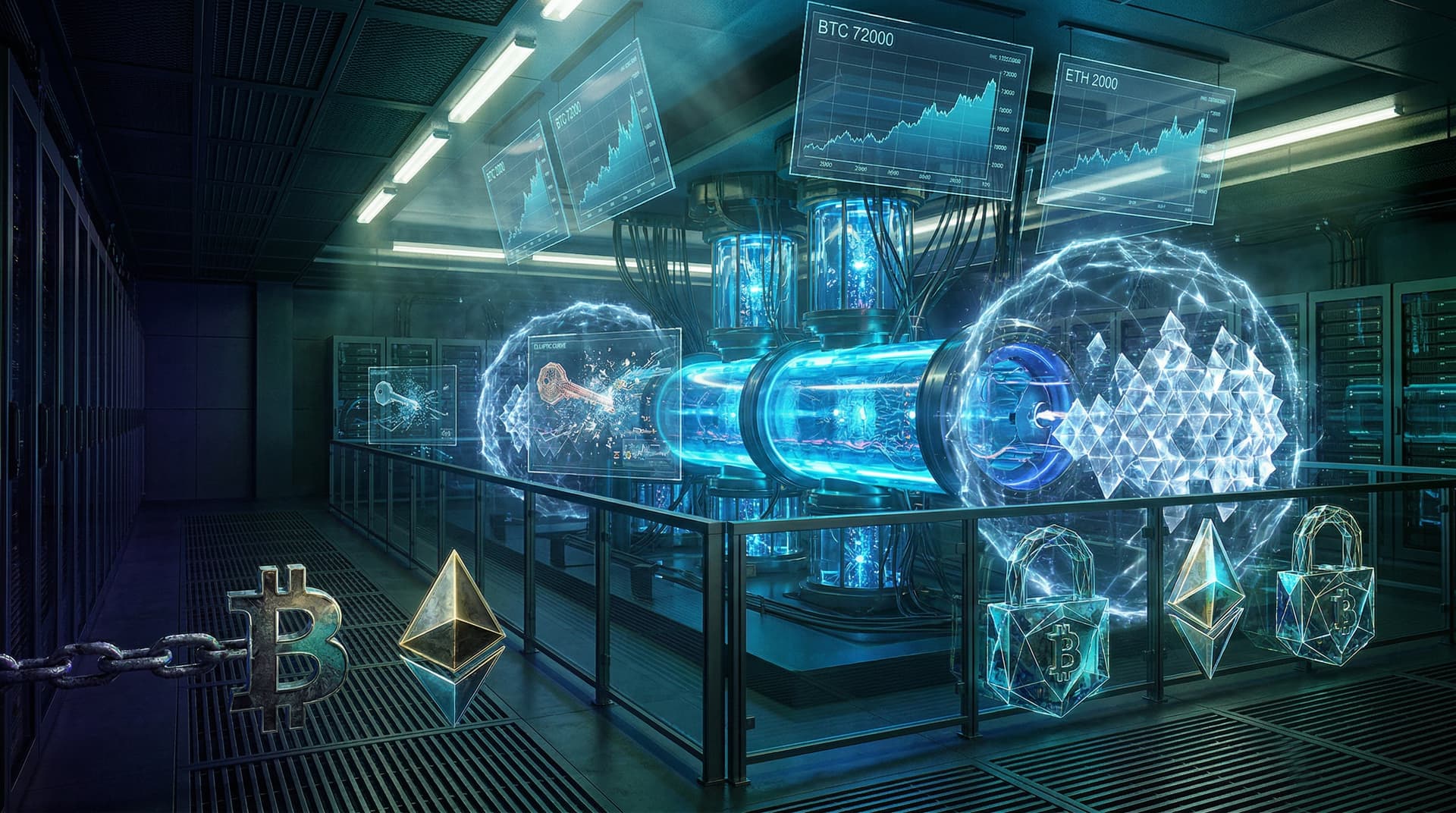
Google Research published a paper on April 10, 2026, exposing quantum vulnerabilities crypto in Bitcoin and Ethereum protocols. The study targets elliptic curve cryptography (ECC) used in digital signatures. Current quantum hardware prevents exploits (Google Research blog, April 10, 2026).
Quantum AI Lab authors recommend immediate migration to post-quantum cryptography. Their report, "Safeguarding Cryptocurrency by Disclosing Quantum Vulnerabilities Responsibly," analyzes threats from Shor's algorithm, which factors large numbers exponentially faster than classical computers.
Google Research Details Quantum Vulnerabilities Crypto Threats
Quantum computers threaten to crack ECDSA signatures securing Bitcoin wallets. A sufficiently powerful device could derive private keys from public keys in hours. Ethereum relies on the vulnerable secp256k1 curve (Google Research, April 10, 2026).
Google simulated attacks using its quantum hardware. Vulnerabilities intensify as qubit counts rise. The Willow chip hit 105 qubits in late 2025, but experts project 1 million logical qubits needed to break 256-bit ECC—advances accelerate this timeline.
NIST confirms these dangers via its post-quantum cryptography (PQC) standards finalized in 2024. Google endorses CRYSTALS-Kyber for key encapsulation and CRYSTALS-Dilithium for signatures. The paper outlines step-by-step blockchain migration strategies, including hybrid classical-quantum schemes.
Impacts on Major Blockchains
Bitcoin's 256-bit elliptic curves reduce to 128-bit security under quantum assault, per Google analysis. Attackers could drain dormant wallets or rewrite transaction histories.
Ethereum's proof-of-stake validators face forged signatures and ETH theft risks. Ripple's XRP Ledger and BNB Chain employ similar ECC primitives, amplifying exposure.
Chainalysis pegs over $1 trillion USD in assets at long-term quantum risk (2026 Crypto Crime Report). Full quantum supremacy looms years away, but preparation starts now.
Market Snapshot: April 10, 2026
Alternative.me's Crypto Fear & Greed Index plunged to 16, extreme fear territory. Bitcoin traded at $72,216 USD on Binance (CoinMarketCap, 14:00 UTC), gaining 1.5%. Ethereum reached $2,217.85 USD, up 1.8%.
USDT stablecoined at $1.00 USD. XRP hit $1.34 USD (+0.8%), BNB $602.41 USD (CoinMarketCap, same timestamp).
Quantum-safe tokens like QRL surged 20%, per PitchBook data.
Google's Responsible Disclosure Process
Google alerted Bitcoin Core developers pre-publication. The team implemented initial patching recommendations.
Quantum AI Lab director Hartmut Neven said, "Responsible disclosure builds trust in emerging technologies" (Google blog, April 10, 2026). The post shares open-source tools for quantum resistance testing.
Ethereum Foundation tweeted: "Thanks to Google for the advance notice on quantum risks—we're prioritizing upgrades." Bitcoin developers propose post-quantum Bitcoin Improvement Proposals (BIPs).
Roadmap to Quantum-Resistant Cryptography
Google champions lattice-based protocols like CRYSTALS-Kyber. Blockchains need hybrid transitions blending old and new signatures.
Bitcoin developers explore Schnorr signatures paired with quantum-safe hashes. Ethereum's Dencun upgrade (March 2026) prototypes PQC features.
Coinbase announces quantum security audits for institutional clients. BlackRock's Bitcoin ETF prospectus flags quantum risks (SEC filing S-1/A, April 10, 2026).
Google's GitHub repository for PQC tools garnered 5,000 stars within hours (GitHub metrics, April 10, 2026).
Fintech and Regulatory Responses
Markets absorbed the news calmly—Bitcoin rose 1.5%. JPMorgan cited the paper in its latest quantum computing report.
SEC Chair Gary Gensler tweeted: "Quantum threats underscore the urgency for robust crypto standards." The EU's MiCA framework mandates post-quantum readiness by 2028.
Venture firm PitchBook reports QRL funding jumped 20% on April 10, 2026, signaling investor shift to quantum-safe projects.
Expert Perspectives on Migration Urgency
Stanford cryptographer Dan Boneh told LatestIcoNews: "Google's disclosure accelerates industry preparedness—we need full migration in five years." He highlights "harvest now, decrypt later" attacks, where adversaries store encrypted data for future quantum decryption.
IBM Quantum synchronizes its roadmaps with Google's findings. Annual audits for high-value wallets top recommendations.
Technological Milestones and Next Steps
Google's Willow processor achieved 105 qubits in 2025; 1,000-qubit systems target 2028. Polygon experiments with quantum-safe zero-knowledge proofs. Optimism's OP Stack integrates Dilithium signatures.
Hardware makers Ledger and Trezor deploy post-quantum firmware updates.
Bitcoin Core schedules quantum BIP discussions for April 15, 2026. Ethereum convenes an all-core developers call on April 11. These proactive measures against quantum vulnerabilities crypto secure blockchain's multi-trillion-dollar future. LatestIcoNews will monitor all upgrades.