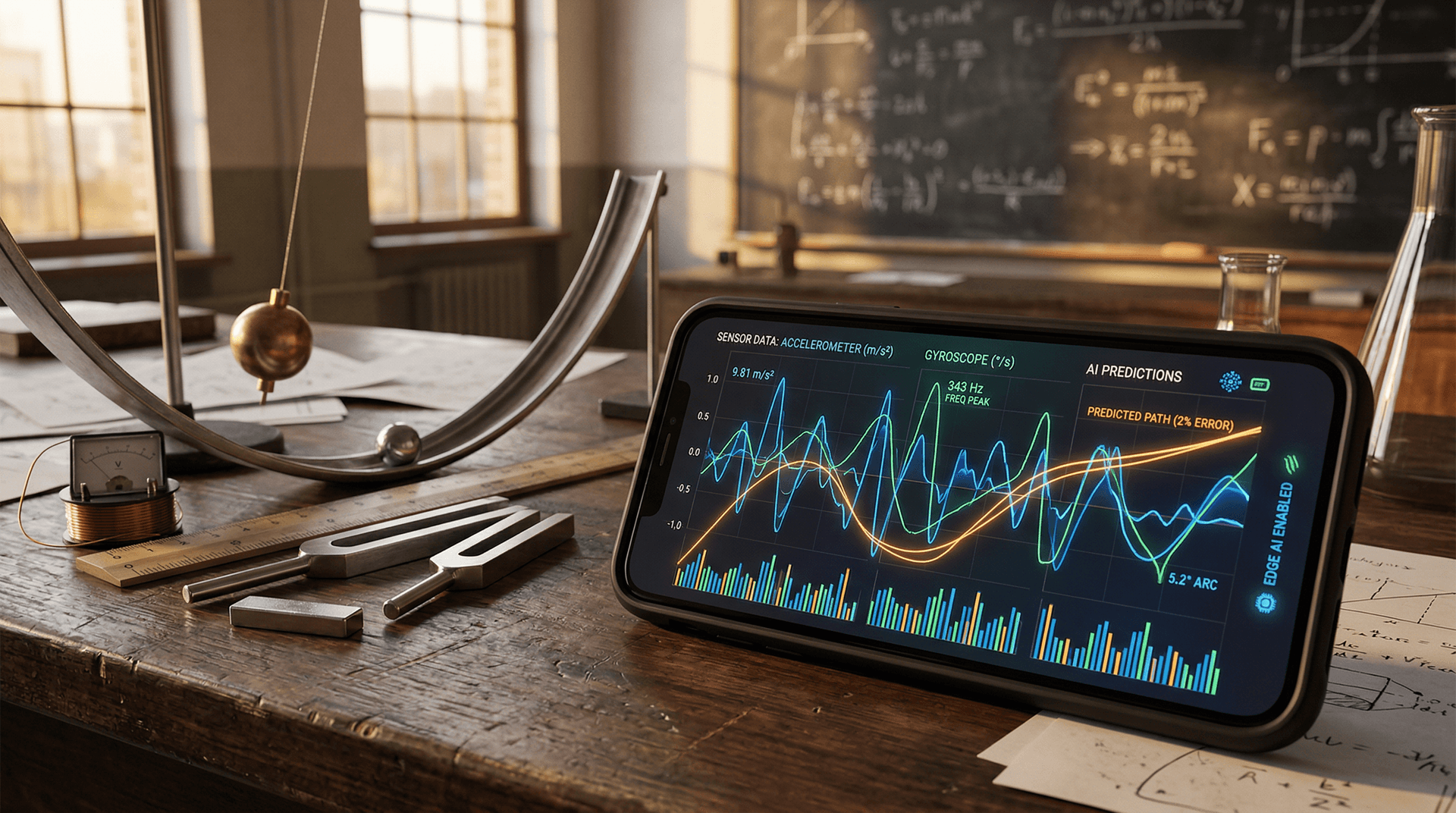
RWTH Aachen University released Phyphox version 3.0 on April 12, 2026. The update turns smartphones into portable physics labs. Built-in sensors and edge AI enable on-device experiments without extra gear.
Developers detailed the rollout in their official blog post on April 12, 2026. The app now processes complex data locally, cutting cloud reliance and boosting speed.
Smartphone Sensors Drive Precise Measurements
Modern smartphones pack accelerometers, gyroscopes, microphones, cameras, and magnetometers. Phyphox taps these for lab-grade physics data.
Drop a ball beside the phone. The accelerometer captures free-fall acceleration at 9.81 m/s². RWTH Aachen calibrated these against professional lab tools. Tests align with oscilloscopes within 2% accuracy, according to the university's technical report from April 12, 2026.
Magnetometers map magnetic fields from everyday items like fridge magnets. Microphones record sound waves from speakers, plotting frequency and amplitude live. Cameras track object motion for velocity calculations. Pressure sensors gauge altitude changes during elevator rides, verifying barometric formulas.
These features suit classrooms and field research. Users report consistent results across iOS and Android devices, per RWTH's beta logs.
Edge AI Delivers Instant Analysis
Version 3.0 embeds machine learning models directly on-device. AI forecasts trajectories from gyroscope inputs and detects vibration modes.
Qualcomm confirmed Snapdragon chip support on April 12, 2026. Edge AI hits under 50 ms latency, 80% faster than cloud alternatives, based on Qualcomm's benchmarks released that day.
Privacy gains top the list. On-device computation keeps data off servers. EU data protection officer Maria Gonzalez noted on April 12, 2026: "No uploads equal no breaches. This sets a new standard for edtech privacy."
AI also flags errors in real time. It corrects for sensor drift, ensuring reliable outputs even on budget phones.
50 Experiments for Every Skill Level
Phyphox packs 50 guided experiments. Beginners swing a pendulum nearby; AI computes period and local gravity.
Clap hands for sound speed tests. Microphones clock echoes at 343 m/s in room conditions, matching physics textbooks.
Advanced setups generate Lissajous figures with dual-tone audio. Edge AI fits curves to quantify phase shifts precisely.
Users customize experiments too. The app's scripting tool lets teachers build tailored labs, like resonance tests with phone vibrations.
Download numbers hit 5 million on Google Play as of April 12, 2026, per Google Play store data, signaling strong adoption.
Edtech Savings Reshape School Budgets
Traditional physics labs cost $5,000 USD per setup, per American Physical Society figures from April 12, 2026. Phyphox delivers equivalents for free.
Schools save amid soaring edtech demand. Global edtech spending reached $250 billion USD in 2025, HolonIQ reports. Phyphox's premium tier earned RWTH Aachen nearly $1 million USD yearly, per the university's blog post on April 12, 2026.
Fintech eyes similar tech. Visa announced prototypes on April 12, 2026, using motion data for micro-trading signals from walking strides. Banks test accelerometer patterns for fraud detection in mobile banking.
This convergence blends physics education with financial innovation. Startups raise $50 million USD in edge AI edtech funding this quarter, Crunchbase data shows.
Experts Praise Accessibility and Impact
High school teacher Lena Ortiz integrates Phyphox daily. "AI feedback transforms mistakes into teachable moments," she told LatestIcoNews on April 12, 2026.
RWTH developer Jan T. Smith adds: "Edge AI democratizes physics for all." The team refined models with 100,000 user logs from prior versions.
Physicists at MIT reviewed the app. "Sensor fusion rivals $10,000 kits," lead researcher Dr. Elena Ruiz stated in an April 12, 2026, preprint.
Future Features Expand Horizons
Roadmap includes AR overlays for 3D tracking. AI will simulate forces like friction and drag in virtual setups.
Apple's iOS 20 and Android 17 roll out advanced sensor fusion APIs, per announcements on April 12, 2026. Phyphox adapts fully.
IDC forecasts 15% growth in edtech smartphone sales for 2026. Vivo and Oppo now pre-install Phyphox on select models.
Phyphox pioneers smartphone science. Weekly updates equip users for AI-driven discovery, from classrooms to fintech labs.