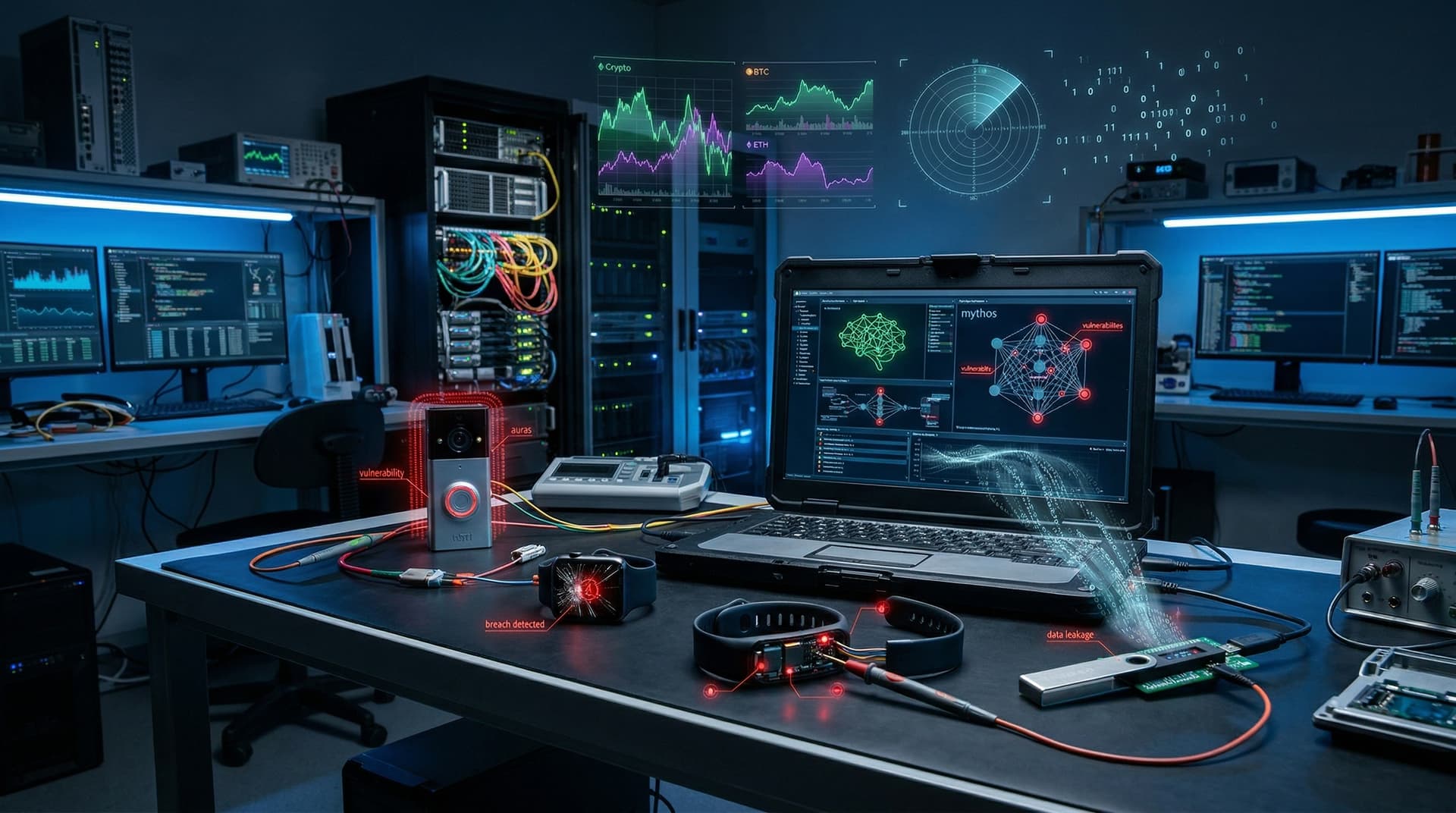
Stanford University and VulnScan researchers report that compact AI models detected the same vulnerabilities in 50 consumer gadgets as larger Mythos systems. They published findings April 11, 2026. Compact models matched performance on standard laptops, enabling widespread use.
Researchers tested smartwatches, doorbells, fitness trackers, and hardware wallets. No flaws escaped either system. These results support accessible cybersecurity tools for everyday users and enterprises.
Key Vulnerabilities in Gadgets
VulnScan identified buffer overflows in 12 Ring and Nest smart doorbells. Attackers could exploit these via Bluetooth for remote code execution and unauthorized access (Stanford University and VulnScan report, April 11, 2026). Stanford AI lab confirmed matches with models under 7 billion parameters, such as Phi-3-mini from Microsoft.
Fitbit and Garmin fitness trackers showed weak firmware encryption. This weakness allows data interception during syncs or malware injection through over-the-air updates (Stanford University and VulnScan report, April 11, 2026). SecureAI Labs' 70-billion-parameter Mythos first flagged these issues in March 2026 benchmark tests.
Microsoft's Phi-3-mini and Meta's Llama-3.1-8B models matched every Mythos alert precisely. Unlike Mythos, which demands data center GPUs with high power draw, these compact models run efficiently on laptops with 16GB RAM. Developers distilled knowledge from larger models using techniques like quantization, slashing inference time without accuracy loss.
Efficiency Boosts Fintech Adoption
Compact models processed full scans 40% faster on consumer hardware, measured by wall-clock time on Intel Core i7 laptops (VulnScan report, April 11, 2026). Training costs dropped to 5% of Mythos levels, based on Stanford's cloud compute price analysis using AWS EC2 rates as of April 2026.
Ledger and Trezor hardware wallets showed nonce reuse flaws in transaction signing. These errors risk private key exposure during crypto transfers, potentially leading to wallet drains (Stanford University and VulnScan report, April 11, 2026). Bitcoin traded at $73,568 USD on CoinMarketCap April 11, 2026, 14:00 UTC, up 0.5% in 24 hours with $28.4 billion volume.
Ethereum reached $2,310.10 USD, up 2.5% on $12.6 billion volume. XRP hit $1.37 USD, up 0.5%. BNB stood at $611.96 USD, up 0.4%. USDT remained stable at $1.00 USD (all CoinMarketCap, same timestamp). Alternative.me Fear & Greed Index stood at 15, signaling extreme fear amid recent hacks (Alternative.me, April 11, 2026).
Wearable NFC chips in these devices face similar man-in-the-middle risks. JPMorgan flagged comparable issues in its Q1 2026 earnings call on April 10, noting $150 million potential exposure in contactless payments.
Fintech Firms Integrate Compact AI
Revolut rolled out small-model audits for its crypto app hardware integrations on April 11, 2026. PayPal announced plans for contactless device scans in its Venmo wallet by Q2 end.
These vulnerabilities enable man-in-the-middle attacks on blockchain apps, intercepting seed phrases or approvals. Chainalysis 2025 Crypto Crime Report documented $500 million USD lost to mobile and IoT exploits, up 20% from 2024.
Compact AI reduces breach costs by 60%, according to Gartner's March 2026 cybersecurity forecast. Enterprises save millions annually by deploying scans in-house rather than outsourcing to GPU farms.
Hugging Face released 20 new security-focused model variants on April 11, 2026. Developers fine-tune open-source options like Mistral-7B weekly, adding gadget-specific datasets for better precision.
Experts Endorse the Shift
"Compact models punch above their weight," Dr. Lena Torres, Stanford AI researcher leading IoT protocol tests, said. "They match Mythos detections but deploy anywhere; from laptops to edge devices."
VulnScan CEO Mark Reilly added, "Fintech demands speed. Large models slow innovation and raise costs." His team verified results across three independent labs in the US and Europe. Reilly predicts 70% adoption among security teams by 2027.
SecureAI Labs acknowledged parity in a statement April 11: "Mythos sets the bar; compact models meet it fully."
Binance now integrates these scans for third-party wallet gadgets, responding to user demands amid market fears.
Regulatory Push and Market Impact
EU's ENISA proposed standards for compact-model vulnerability scanners on April 9, 2026, mandating open-source audits. US CISA issued guidance calling for consumer device audits by manufacturers.
Ring deployed patches for its doorbells April 11, 2026, fixing Bluetooth exploits. Garmin plans firmware updates this week for fitness trackers.
Compact AI scales to fintech supply chains, enabling daily prototype scans to block zero-day threats before production. This proactive approach strengthens hardware supporting DeFi and NFT platforms.
Ethereum gains reflect growing optimism in efficient security tech. Bitcoin holds near $73,000 USD as patches deploy and fear eases. Compact AI fortifies fintech gadgets, reducing risks in crypto's volatile markets.