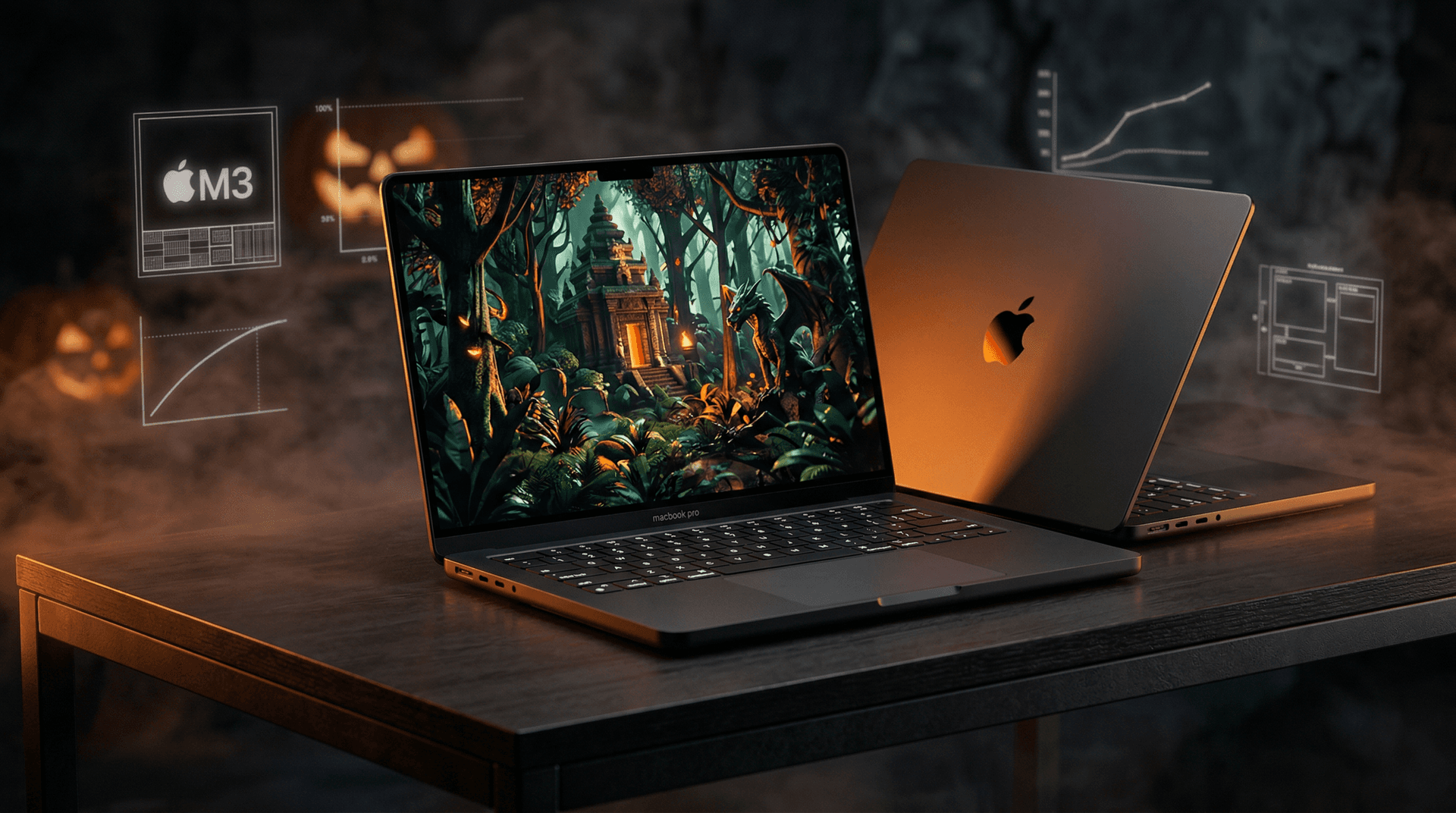
Apple's surprise 'Scary Fast' event on October 30, 2023, just in time for Halloween, delivered thrills with the announcement of its third-generation Apple Silicon chips: the M3, M3 Pro, and M3 Max. Integrated into updated 14-inch and 16-inch MacBook Pro models, plus a refreshed iMac, these chips promise unprecedented efficiency and power. As a senior tech journalist, I've pored over the specs, demos, and early benchmark teases to bring you this comprehensive review. Is this the ultimate laptop for creators, developers, and power users? Let's break it down.
Event Highlights: What Apple Showed Off
The virtual event was concise—under 30 minutes—but packed with demos showcasing the M3 family's prowess. Key takeaways:
- Hardware Ray Tracing Debut: For the first time, Apple Silicon supports hardware-accelerated ray tracing, a game-changer for 3D rendering, gaming, and visual effects. Combined with dynamic caching and mesh shading, the M3 Max's 40-core GPU can handle complex scenes at blistering speeds.
- CPU and GPU Upgrades: The base M3 features an 8-core CPU (4 performance + 4 efficiency cores) and 10-core GPU. M3 Pro scales to 12-core CPU and 18-core GPU, while M3 Max hits 16-core CPU and up to 40-core GPU. Apple claims up to 2.5x faster ray-traced graphics than M1 Max and 65% faster CPU performance than comparable PC chips.
- Display and Design Tweaks: The Liquid Retina XDR displays now peak at 1600 nits for HDR content (up from 1000 nits sustained). A new Space Black finish joins Silver, but the design remains unchanged—no mini-LED shift yet, notch persists. Ports include HDMI, SDXC, MagSafe 3, and three Thunderbolt 4/USB4.
- Battery and Efficiency: Expect all-day battery life, with the M3 Pro and Max enabling thinner designs in theory, though chassis sizes are identical.
Demos included Blender renders flying through in seconds, a 65% faster Final Cut Pro export versus M1, and smooth 8K ProRes playback. Gaming previews with Resident Evil 4 highlighted ray-traced shadows at 60fps.
Deep Dive: M3 Chip Architecture
Building on the 3nm process (same as M2? Wait, no—Apple confirmed M3 uses a refined second-gen 3nm TSMC node for better density and efficiency), the M3 family integrates more transistors: 25 billion in M3, up to 92 billion in M3 Max.
| Chip | CPU Cores | GPU Cores | Neural Engine | Memory Bandwidth | Transistors |
|---|---|---|---|---|---|
| M3 | 8 (4P+4E) | 10 | 16-core | 100GB/s | 25B |
| M3 Pro | 11-12 | 14-18 | 16-core | 150GB/s | ~37B |
| M3 Max | 14-16 | 30-40 | 16-core | 400GB/s | 92B |
The GPU shines with second-gen ray tracing engines per core, enabling realistic lighting without melting your laptop. Media engine upgrades support AV1 decode for efficient streaming. Neural Engine hits 18 TOPS for AI tasks like photo enhancement in Photos app.
Compared to M2:
- M3 GPU: 20% faster.
- M3 Pro/Max: Up to 2x graphics performance.
Early Geekbench leaks (pre-release units) show M3 single-core ~3,100, multi ~15,000—edging Intel's latest Core Ultra and AMD's Ryzen 7000 in efficiency.
MacBook Pro Models: Specs and Pricing
14-inch MacBook Pro:
- Starts at $1,599 (M3, 8GB RAM, 512GB SSD, 10-core GPU).
- M3 Pro config: $1,999 (512GB SSD, 18GB RAM).
- Up to M3 Max: $3,199+.
16-inch MacBook Pro:
- M3 Pro from $2,499.
- M3 Max up to $7,349 (128GB RAM, 8TB SSD, 40-core GPU).
iMac (24-inch) with M3 starts at $1,299, now with 8-core GPU option and ray tracing.
Customization remains flexible: up to 128GB unified memory, 8TB SSD. No base 8-core GPU anymore—standard 10-core on M3.
Performance Impressions: Real-World Winners
From Apple's charts:
- Video Editing: Final Cut Pro on M3 Max exports a 14-stream 8K ProRes project 3.4x faster than M1 Max.
- 3D Rendering: Blender BMW27 scene renders 2.2x quicker on M3 Max vs. M1 Max.
- Gaming: Shadow of the Tomb Raider at 1080p ultra with ray tracing: 55fps on M3 Max.
For developers, Xcode compiles are snappier, and ML training accelerates. Battery claims: 22 hours video playback on 14-inch M3.
Pros:
- Blistering GPU for pros (VFX, AAA games).
- Stunning display brightness.
- Silent operation, fanless potential on base M3.
Cons:
- Incremental CPU gains over M2 Pro/Max.
- No design refresh or OLED.
- Premium pricing; base M3 feels mid-tier now.
Who Should Buy?
- Upgrade from Intel Macs: Absolutely—night-and-day efficiency.
- M2 Owners: Wait unless you need ray tracing or Max GPU.
- Windows Switchers: If you crave battery life and macOS ecosystem, yes.
Pricing undercuts high-end PCs while matching performance. Availability starts November 7, 2023.
Verdict: 9.5/10
The M3 MacBook Pro isn't revolutionary in form but evolutionary in function. Ray tracing unlocks new creative frontiers, making it the best pro laptop today. For power users, it's a scream—er, scary fast indeed. Stay tuned for full benchmarks post-launch.
Word count: 912